The Shopify plan is not what makes Shopify expensive in Nigeria. Nigerian sellers pay in three places, and the subscription is the one everybody budgets for and the smallest of the three.
Here is where the other two hide, how to work out your real monthly cost before you commit, and what to use instead if the sum comes back ugly.
The three costs of running Shopify from Nigeria
One: the plan, in dollars. Shopify does not price its Nigerian plans in naira. The Basic plan is around $29 a month billed monthly, less if you pay for the year. Your bank converts at whatever rate it feels like on the day, so the same plan is a different amount of money every month, and your card has to be able to pay in dollars at all. Plenty of Nigerian cards still cannot, which is its own small industry of workarounds.
Two: the extra fee for using a Nigerian gateway. Shopify Payments is not available in Nigeria. Every Nigerian seller therefore uses a third party to take the money, and Shopify charges roughly 2% per online order on the Basic plan for the privilege. That sits on top of whatever your gateway already charges you. You are paying two companies to move the same naira.
Three: the build. A theme that looks like your brand, the apps that add the things the base store does not do, and, for most sellers, somebody paid to put it all together. This is the cost nobody forecasts and the one that usually dwarfs the other two in month one.
All three checked in September 2026. Dollar prices and rates move, so put your own numbers in.
Work out your real monthly cost
Do this before you sign up for anything, not after.
Take the plan in dollars and multiply by the rate your bank actually used last time, not the rate you saw on the news. Add 2% of last month's sales. Add whatever a theme and your apps come to, divided over twelve months. Add what you would pay someone to set it up, also divided over twelve.
Now divide that total by your orders per month.
A seller doing 30 orders a month often finds the answer is somewhere north of ₦1,500 an order before a single item has been packed. On a ₦6,000 product, that is most of the profit.
When Shopify is worth every kobo of it
This is not an argument that Shopify is bad software. It is very good software, and for a particular seller it is the only right answer.
Stay on Shopify, or go to it, if a real share of your customers pay in dollars or pounds and you ship abroad. If you want control of how the store looks down to the code. If you depend on a specific app from their app store. If you already have a working store and a developer and it is paying for itself.
That seller exists in Nigeria, and they are usually not the person searching for an alternative at 11pm.
What Nigerian sellers usually need instead
Most Nigerian sellers are not running a website business. They are running a WhatsApp business with a link attached.
The orders start in a DM, a status reply or a comment. The buyer wants to ask one question before paying. The payment is a card or a transfer, in naira. The whole thing happens on a phone, usually theirs and yours both.
A storefront built for that flow beats a store built for search traffic you have not got yet.
The alternatives worth looking at, by what you sell
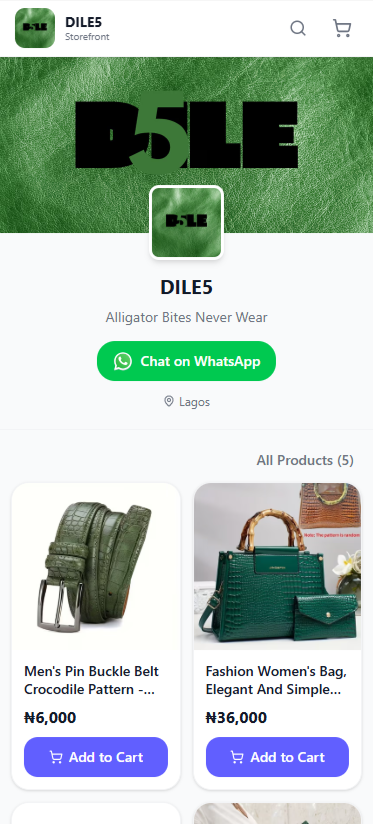
Physical goods sold through social media. SendSawa. Priced in naira, so the bill does not move with the rate. Free plan with 10 products and no end date, ₦5,000 a month for unlimited. Card and bank transfer through Korapay, a WhatsApp button beside the cart, and 0% taken from your sales with no extra charge for using a Nigerian gateway. Live in about 5 minutes. What you give up is deep design control and a big app store.
Digital products and courses. Selar. Built for delivering a file or a course, with course hosting and email marketing. It charges a fee on each sale, around 4% + ₦50 on naira transactions, so it is cheapest when your volume is low and gets more expensive as you grow.
A shop with a counter and staff. Bumpa. POS, staff accounts and stock across locations, from ₦15,000 a quarter. Overkill for a phone business, right for a real shop floor.
Nothing but a payment link. Paystack Storefront, free with a Paystack account. It is a product list beside your payment account rather than a shop, which is enough until it suddenly is not.
Shopify and SendSawa, feature by feature
| Feature | SendSawa | Shopify |
|---|---|---|
| Priced in naira | Yes | No |
| Entry price | ₦0 | About $29/month |
| Extra fee for a Nigerian gateway | 0% | About 2% on Basic |
| Card and transfer for Nigerian buyers | Yes | Through a third party |
| WhatsApp order button built in | Yes | Needs an app |
| Setup time | About 5 minutes | Days, often with help |
| Needs a paid theme | No | Often |
| Needs paid apps to finish the job | No | Often |
| Free store link with no domain to buy | Yes | Trial link only |
| Selling to buyers outside Nigeria | Limited | Yes |
| Deep design control | 4 themes | Yes |
| Large app store | No | Yes |
| Free social media page audit tool | Yes | No |
Shopify's published prices and Nigeria availability checked in September 2026.
What SendSawa includes that a feature table usually misses
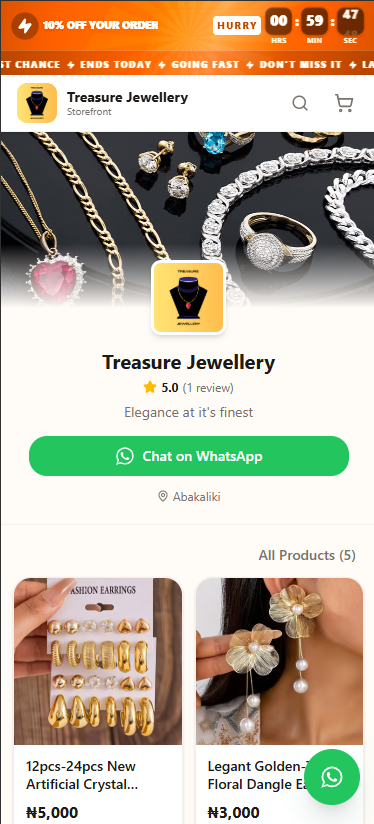
Offers that give somebody a reason to buy today. A countdown bar across the top of your store with a real deadline on it, and a scrolling strip under it doing the shouting. "Buy more, pay less", so the second item costs less than the first and your average order goes up. Flash offers on a single product. All on the Growth plan.
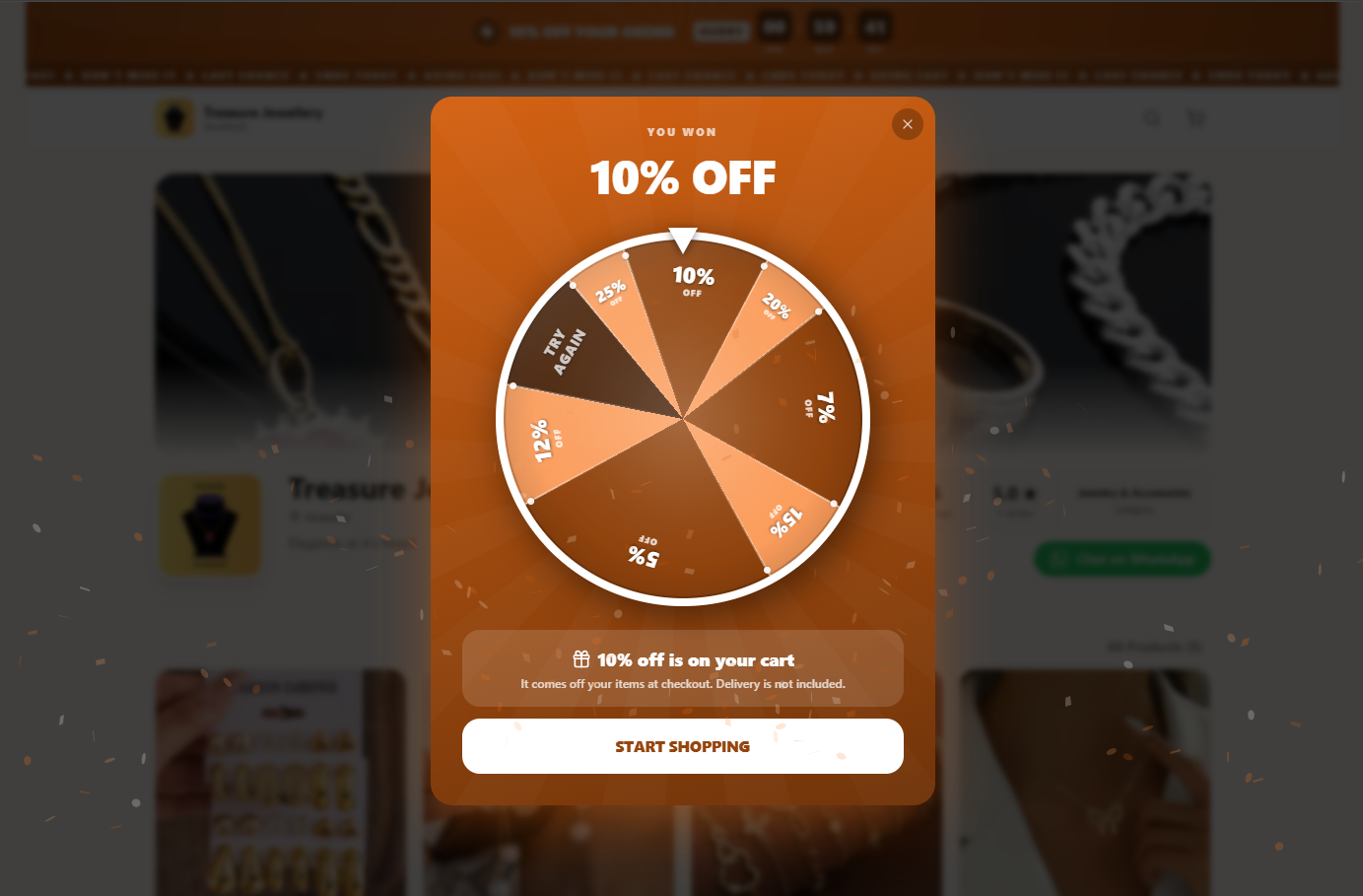
A prize wheel that greets people when they open your store. The wheel shows other numbers around the edge so the spin is worth watching, but it always stops on the discount you set. Nobody can win more than you decided to give away, and the discount lands on their cart before they reach checkout.
Follow-ups for the people who left without paying. Every buyer who filled a cart and disappeared lands in one list, with the message already written and a button that sends it on WhatsApp. Those are people who already chose the item, so it is the cheapest order you will take all week.
Reviews from people who actually bought. A review can only be left against a real order, so what sits on your storefront is not something a competitor or a friend can invent.
A free page audit, whether or not you ever open a store. Paste your Instagram, TikTok, X or Facebook page into the free page audit and you get a score out of 100 and the specific things to fix so more of your followers order. No sign up, no card, nothing to install. None of the other tools compared here offers anything like it.
Your customers, your analytics and your payouts in the same place. Who bought what, what is selling, and what is on its way to your bank, without a spreadsheet.
Questions sellers ask
Why is Shopify so expensive in Nigeria? Three costs stack: the plan is billed in dollars and converted by your bank, Shopify Payments is not available here so you use a third-party gateway and Shopify adds roughly 2% per online order on Basic, and most stores need a paid theme, paid apps or paid help to launch.
What is the best Shopify alternative in Nigeria? It depends what you sell. Physical goods through WhatsApp and Instagram: SendSawa. Courses and downloads: Selar. A shop with a counter: Bumpa.
Can I use Shopify in Nigeria at all? Yes. It works, and plenty of Nigerian stores run on it. The question is whether what it costs you per order is worth what it gives you over a naira-priced tool.
Do I need a domain name to sell online? No. A SendSawa store comes with its own link you can share immediately, so you can start selling and sort out a custom domain later, or never.
Will I lose my Shopify store if I try something else? No. Build the new one on a free plan alongside it, move your traffic, and only cancel once the new store has taken real orders.
What to do this week
Take last month's Shopify invoice, add 2% of last month's sales, divide by your orders. If that number is bigger than you are comfortable saying out loud, spend one evening rebuilding your ten best sellers somewhere priced in naira and point your bio link at it for a week.
Then run the page your buyers actually land on through the free page audit while you are at it. No platform fixes a bio that never tells anybody how to order.