Feature lists are a terrible way to choose a selling platform. Every list is written by the company that wins on it, and the tool with more rows always looks like the better buy, even when half those rows are for a business you do not run.
A better way to choose: describe your Tuesday. Then pick the tool that makes your Tuesday shorter. Here is how Bumpa and SendSawa each handle a Nigerian seller's Tuesday, including the version of that Tuesday where Bumpa is clearly the right answer.
Two Tuesdays
Tuesday one. You wake up to 14 unread DMs. Four are "how much", three are "is it still available", two want to know if you deliver to Port Harcourt, and one person sent a transfer receipt at 11pm that you now have to match against an order. You spend the morning typing prices you have typed a hundred times. You pack two parcels. By evening you are not sure how many orders you actually took.
Tuesday two. You open the shop at 9. Your assistant is on the till. Somebody returns a top bought last week and you need to find that sale. Stock has to move from the shop to the store room. Two staff need to be paid on what they sold, so you need the sales split by person. You want an SMS out to your customer list about Friday.
These are different businesses. They need different software, and the pricing page is not where you find that out.
What each one is built around
Bumpa is built around running a business with moving parts. Its centre of gravity is POS, staff accounts, stock across locations, and campaigns. The online store is one part of a larger system.
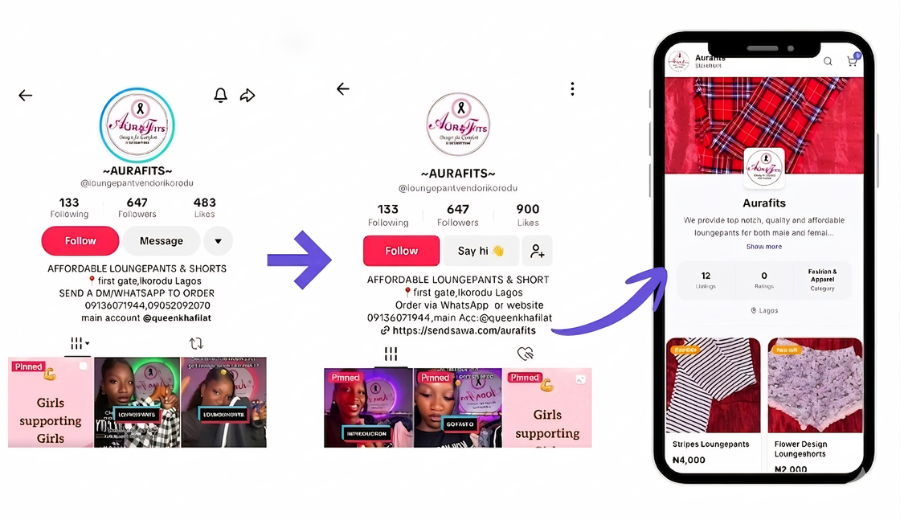
SendSawa is built around one link. The centre of gravity is the storefront a customer opens from your bio or your status, a cart, payments, and an order list. There is no POS and no staff accounts, on purpose.
If your day is Tuesday two, the second tool will feel thin. If your day is Tuesday one, the first will feel like buying a lorry to carry your handbag.
Bumpa vs SendSawa, feature by feature
Both take 0% of your sales. Neither takes a percentage of what your customer pays you, so the whole comparison comes down to the subscription and what it includes.
| Feature | SendSawa | Bumpa |
|---|---|---|
| Starting price | ₦0 | ₦0 (limited) |
| First paid plan | ₦5,000/month | ₦15,000/quarter |
| Monthly billing | Yes | No |
| Cut of your sales | 0% | 0% |
| Products on the free plan | 10 | Limited |
| Unlimited products | ₦5,000/month | On paid plans |
| Shareable store link | Yes | Yes |
| WhatsApp ordering | Yes | Yes |
| Card and bank transfer | Yes | Yes |
| Storefront themes | 4 on Growth | Yes |
| Remove the badge from your store | On Growth | On paid plans |
| Customer list | Yes | Yes |
| POS app | No | Yes |
| Staff accounts | No | Yes |
| Several locations | No | Yes |
| SMS and email campaigns | No | Yes |
| Built for social media sellers first | Yes | Broader focus |
| Free social media page audit tool | Yes | No |
Prices as published on both companies' own pages in September 2026.
The monthly headline rate lands in the same place. The difference is when the money leaves your account. Quarterly billing means a slow month is paid for in advance by a good one, which is fine when your months are steady and painful when they are not.
What SendSawa includes that a feature table usually misses
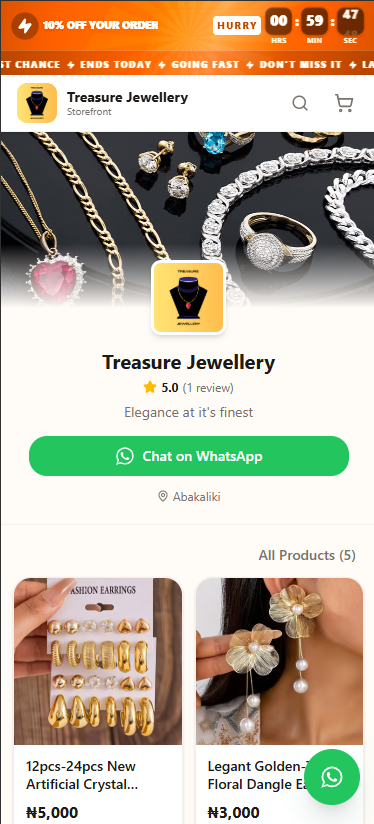
Offers that give somebody a reason to buy today. A countdown bar across the top of your store with a real deadline on it, and a scrolling strip under it doing the shouting. "Buy more, pay less", so the second item costs less than the first and your average order goes up. Flash offers on a single product. All on the Growth plan.
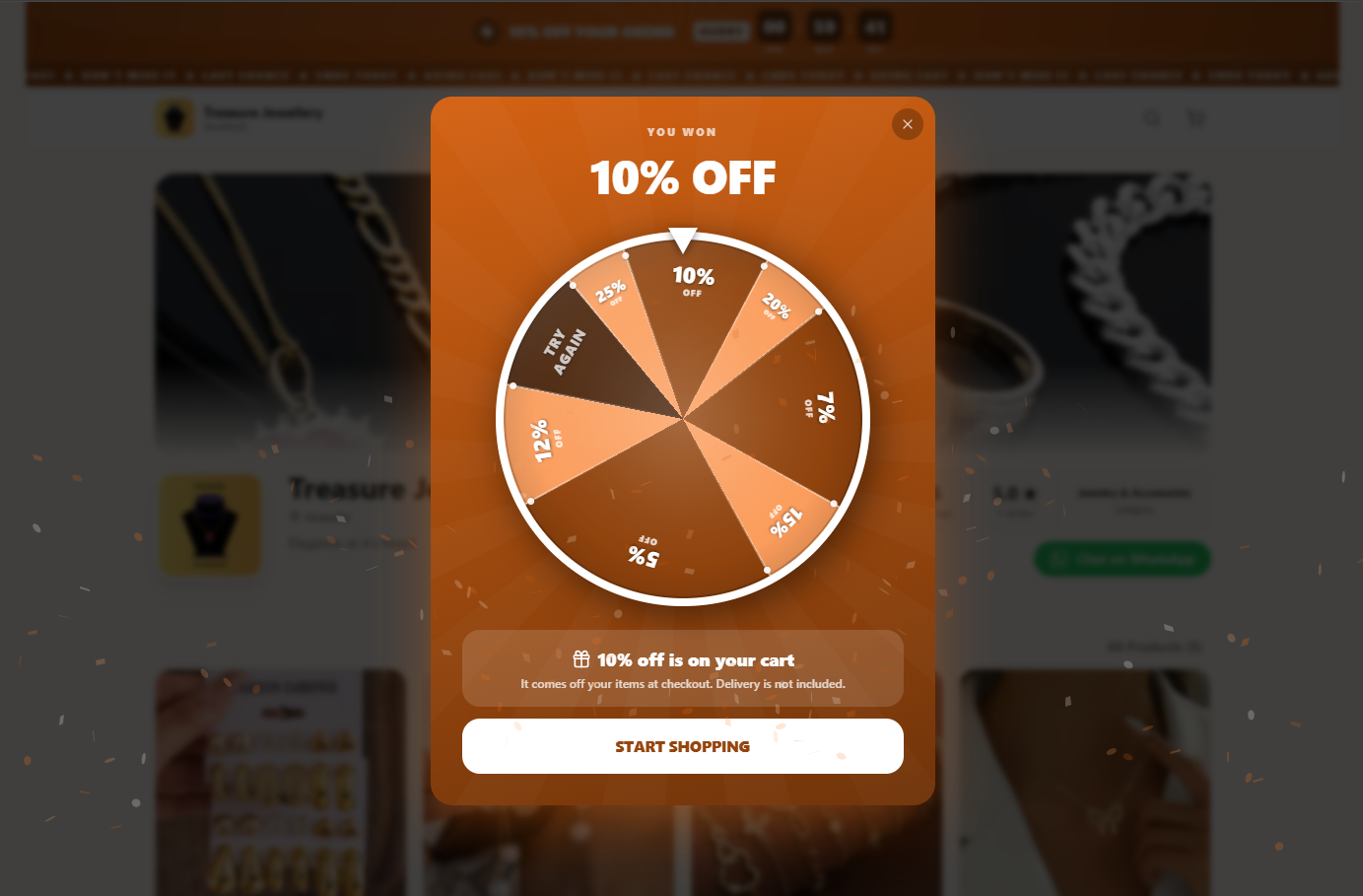
A prize wheel that greets people when they open your store. The wheel shows other numbers around the edge so the spin is worth watching, but it always stops on the discount you set. Nobody can win more than you decided to give away, and the discount lands on their cart before they reach checkout.
Follow-ups for the people who left without paying. Every buyer who filled a cart and disappeared lands in one list, with the message already written and a button that sends it on WhatsApp. Those are people who already chose the item, so it is the cheapest order you will take all week.
Reviews from people who actually bought. A review can only be left against a real order, so what sits on your storefront is not something a competitor or a friend can invent.
A free page audit, whether or not you ever open a store. Paste your Instagram, TikTok, X or Facebook page into the free page audit and you get a score out of 100 and the specific things to fix so more of your followers order. No sign up, no card, nothing to install. None of the other tools compared here offers anything like it.
Your customers, your analytics and your payouts in the same place. Who bought what, what is selling, and what is on its way to your bank, without a spreadsheet.
The part most comparisons skip: how long setup takes
A SendSawa store is usually live in about 5 minutes. That is not because the software is faster. It is because there is less of it. You add products, prices and photos, and the link works.
A full Bumpa setup takes longer for the same reason in reverse. Stock, staff, POS and locations all need configuring before the system does what it is good at. That time is worth spending if you are going to use those parts. It is dead time if you are not.
Ask yourself which failure you would rather have: a tool that is ready before you have finished your tea but cannot handle a second shop, or a tool that handles the second shop but is still half configured a fortnight later.
Where Bumpa wins, plainly
Pick Bumpa if you have a counter and need POS. Pick it if your staff each need a login. Pick it if stock sits in more than one place, or if SMS and email campaigns are part of how you sell. Pick it if you would rather have one app for the whole business and you are happy to pay for the parts you do not use yet.
None of that is a small list, and pretending otherwise would just make this article less useful to the person it is wrong for.
Where SendSawa wins
Pick SendSawa if your shop lives in your bio and your DMs. If most of your orders start on WhatsApp, Instagram or TikTok. If your catalogue is small enough that ten free products is a real start, or big enough that ₦5,000 a month for unlimited is obviously worth it. If you want to be selling this evening rather than next weekend.
Questions sellers ask
Which is better, Bumpa or SendSawa? Neither, in the abstract. Bumpa is better for a business with a counter, staff and stock in more than one place. SendSawa is better for someone selling through a link on social media who wants a storefront up in minutes for ₦0 to start.
Which one is cheaper? SendSawa at the entry level: ₦0 to start with no end date, then ₦5,000 a month or ₦4,000 paid yearly, against ₦15,000 a quarter for Bumpa's cheapest paid plan.
Do either of them take a percentage of my sales? Not on the plans compared here. Both are 0%. Whoever processes your payments still has their own charges, on either platform.
Can I use both? Yes, and it is the sensible way to decide. Keep your current account, build the other store free, and run both links for a week.
Do both work with WhatsApp? Yes. On SendSawa your storefront carries a Chat on WhatsApp button beside the cart, so a buyer with a question does not have to leave and find your DMs.
The test that settles it
Load your ten best sellers into the free plan of whichever one you are not on. It costs nothing, takes an evening, and by next week you will know from your own orders rather than from anybody's comparison table.
And before you spend another naira on either one, put your page through the free page audit. A bio that does not tell people how to order will waste whichever storefront you pick.